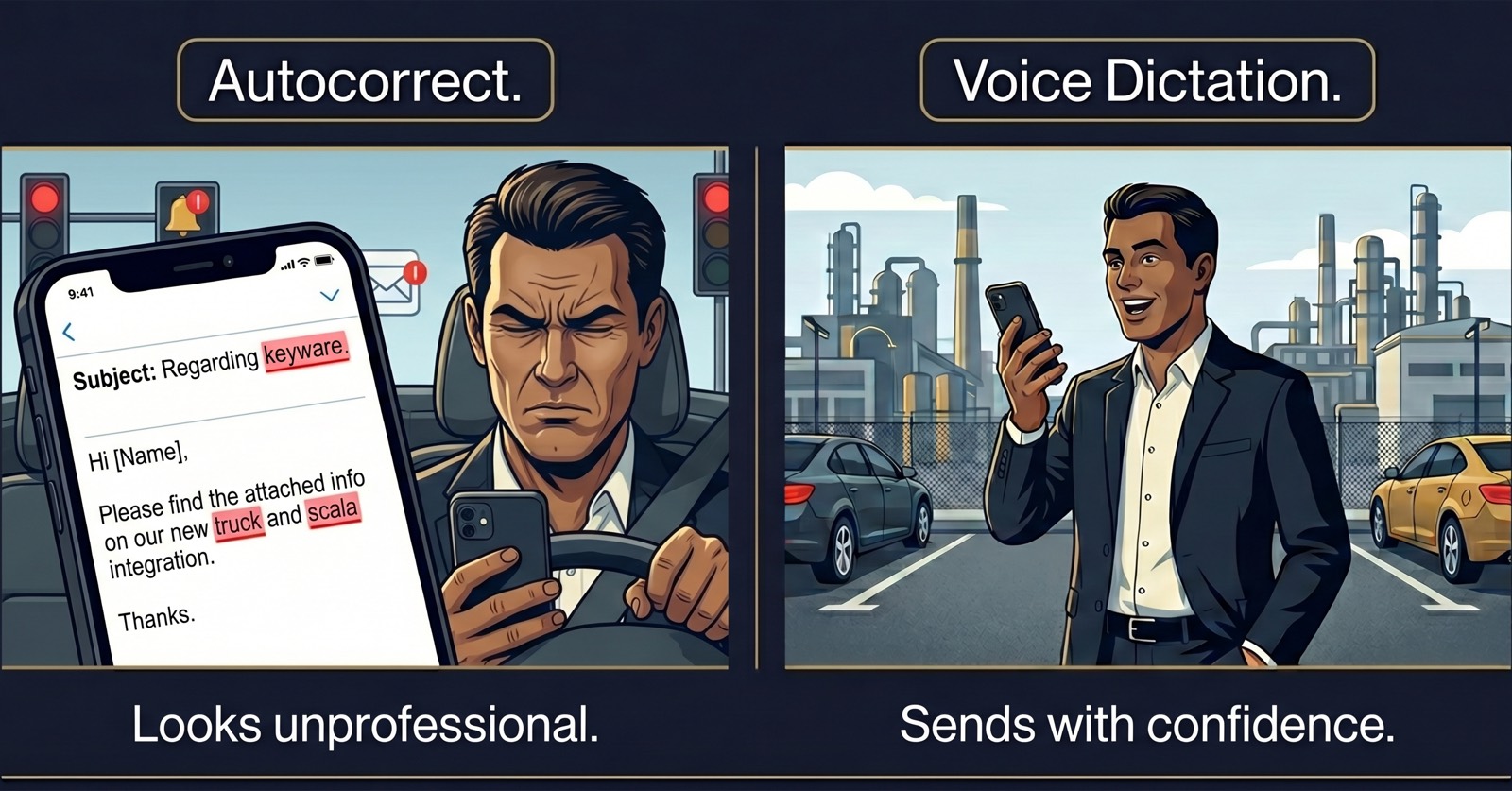
There's a particular kind of frustration that every manufacturer's rep and distributor knows well.
You're firing off a quick email between calls — something simple, just checking in on a quote or confirming a delivery — and autocorrect quietly rewrites half of it. You hit send. Three seconds later you realize “Turck” went out as “truck,” “Kepware” became “keyware,” and “SCADA” somehow turned into “scala.”
It sounds minor. It isn't.
In industrial automation, your product knowledge is your credibility. The brands you represent, the terminology you use, the way you communicate technically — all of it signals whether a customer can trust you with a serious project. A badly autocorrected email doesn't just look sloppy. It makes you look like you don't know the line card you're selling.
The line card problem
If you carry a lot of lines — Banner, Turck, PULS, Fortress, Advantech, Pepperl+Fuchs, Beckhoff — you already know that almost none of those names exist in any phone's default dictionary. Neither do half the product families, model numbers, or technical terms that come up daily in customer conversations.
So every time you type on your phone, you're fighting autocorrect the entire way. And even when you win — even when you catch every substitution before you hit send — you've spent extra time double and triple checking a two-paragraph email that should have taken thirty seconds.
A lot of reps just stop fighting and send it anyway. You've seen those emails. Everyone has. The message is technically readable but clearly thumb-typed in a hurry, full of odd substitutions and half-corrected terms. You can spot it immediately. And so can the customer.
What accurate voice dictation actually changes
The difference isn't just speed. It's trust.
When your dictation understands the vocabulary you actually use — the brands, the acronyms, the technical shorthand of automation sales — you stop second-guessing every outbound message. You say what you mean, it comes out right, and you move on.
That's not a small thing when you're managing thirty accounts and trying to look sharp across all of them simultaneously.