Ask any experienced sales manager what separates a good rep from a great one and you'll hear a lot of answers. Product knowledge. Relationships. Hustle. Technical depth.
They're not wrong. But the real differentiator — the one that compounds over time and quietly builds a book of business — is the follow-up. Specifically, how fast it happens and how reliable it is.
Why the follow-up matters more than the call
The best part of field sales is the call itself. Walking a facility, talking through a tough application, vibing with a customer who actually wants your input on a real problem. That part doesn't feel like work.
But the call is just the setup. What the customer actually remembers — what builds trust over time — is whether you closed the loop. You came, you listened, you looked at the application, you took notes. And then you came back to them with a summary, a next step, a quote, a recommendation. Quickly. Before they had to ask.
That loop, closed fast, is what gets you the next call. And the one after that.
What actually happens in the field
Here's the reality. You finish a solid site visit at 10am. You have another call at 11:30. Between those two stops your phone has already collected three new emails, two texts, and a voicemail from a different account with an urgent question.
By the time you finish your second call it's 1pm and you've mentally moved on to the application you just looked at. The follow-up from the morning call is still sitting in your head, unwritten. You tell yourself you'll handle it at the end of the day.
End of the day comes. You've been in front of ten different applications, absorbed ten different sets of technical details, and fielded a full day of inbound noise. You're burnt out. The follow-up either gets written tired and fast, or it gets pushed to tomorrow.
Tomorrow it's competing with everything else again.
In an industry where speed to market is everything — where your customer is also moving fast and evaluating options — that delay costs you. Not dramatically. Just incrementally, call after call, until a competitor who follows up faster starts getting the first call on new projects.
The fix isn't discipline. It's friction.
The reason follow-ups get delayed isn't laziness. It's friction. The moment between finishing a call and sending a summary requires sitting down, opening a laptop, organizing your thoughts, and writing something professional enough to send to a customer.
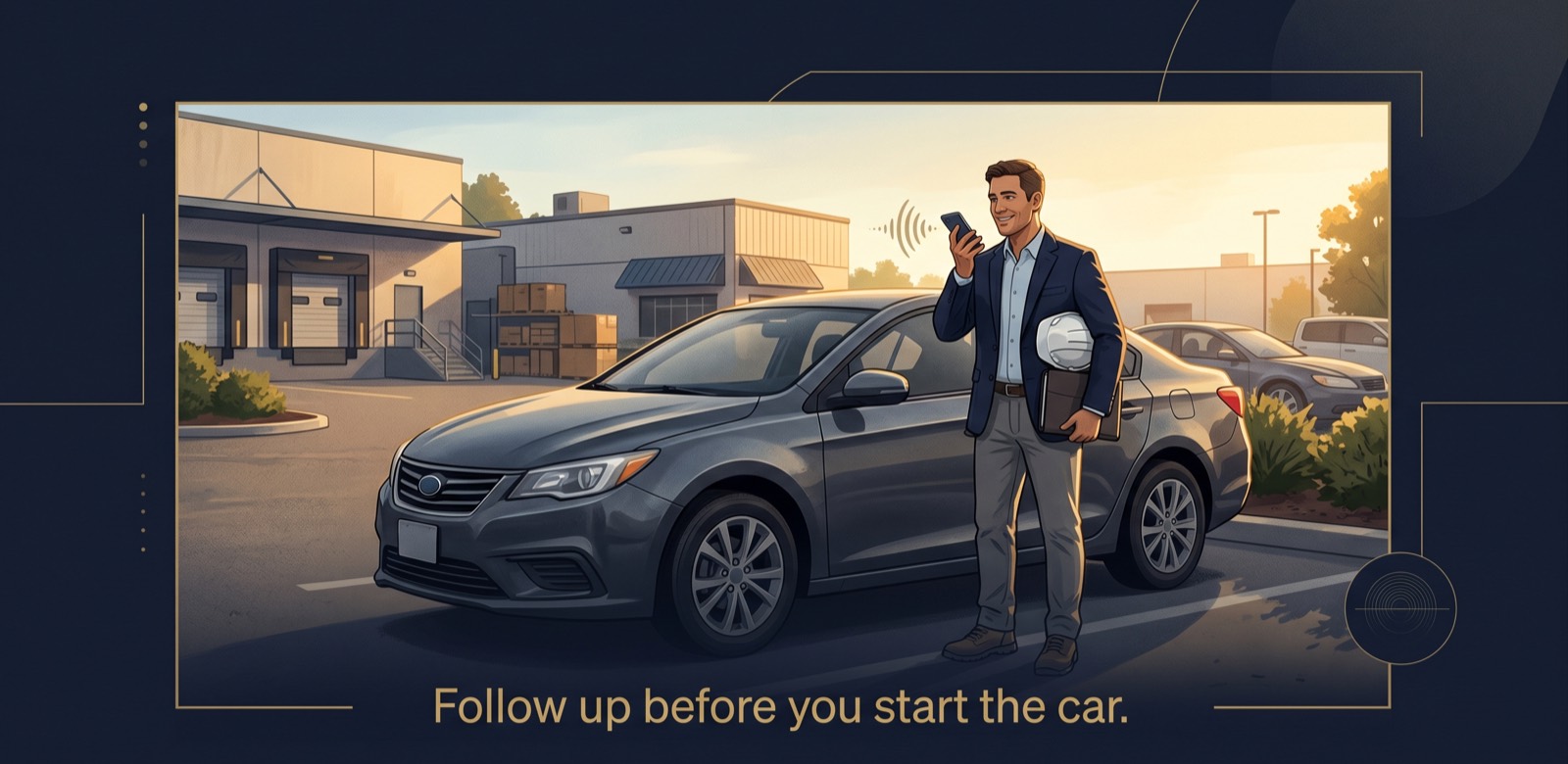
Remove that friction — be able to dictate a clean, accurate follow-up summary from the parking lot before you start your car — and the loop closes in two minutes instead of two days.
That's the difference.