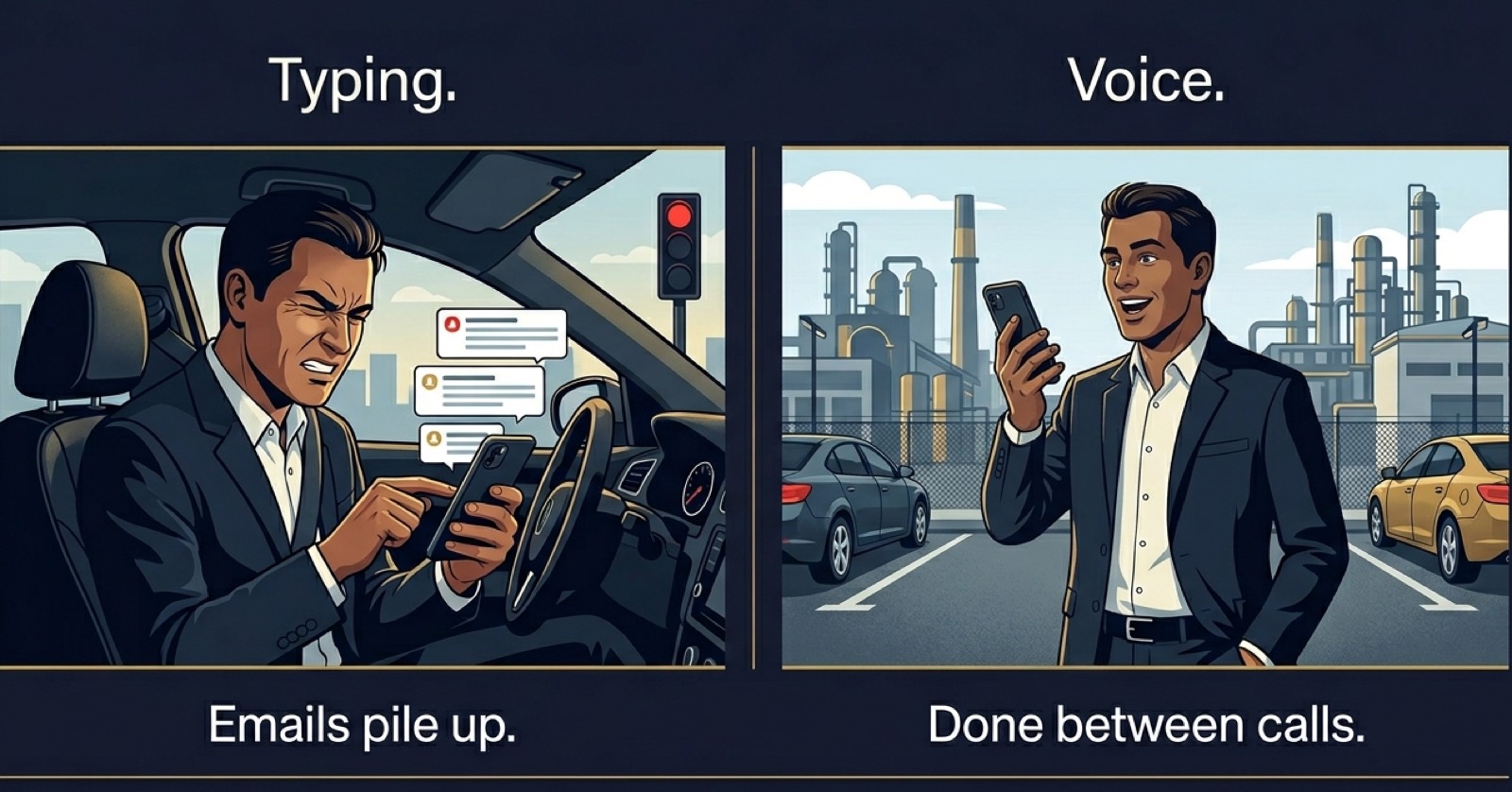
If you've spent any time in field sales, you know the feeling.
You walk into a customer's facility for a scheduled call and before you even sign in at the front desk, your phone is already buzzing. Three messages from other accounts. One wants to know where their hardware shipment is. Another needs a quote updated. A third has a technical question about a drive configuration.
All of them need a response. None of them are complicated. And you don't have time for any of them right now.
So you do what most reps do — you leave them alone and tell yourself you'll handle it at lunch.
Except lunch comes and goes, and now there are eight messages instead of three. You pull out your laptop in a Chick-fil-A parking lot and start typing. The experience is exactly as bad as you'd expect. By the time you're back on the road, you've answered four of them and punted the rest to tonight.
Then tonight comes. You're home. You're tired. You open your laptop and finish what should have taken twenty minutes total.
The typing problem nobody talks about
Typing on a phone sounds trivial until you're doing it in the field. Technical automation terminology destroys autocorrect. “Kepware” becomes “keyware.” “VFD” becomes “vid.” “Turck” becomes “truck.” Every message needs a proofread, and proofreading on a 6-inch screen after a full day of calls is its own kind of miserable.
So you either send sloppy messages to customers — which reflects on you — or you spend twice as long fixing them. Neither is a good option.
And the alternative most reps resort to — typing at a red light, pulling over at a gas station, pecking out a response while the car is running — is inefficient at best and dangerous at worst.
What changes with voice
Voice dictation at the keyboard level means you talk the way you think. You don't open a separate app, you don't switch workflows, you don't lose your place. You're in your email or your CRM, you hold a button, you say what you need to say, and it comes out clean.
Not transcribed-and-hope-for-the-best clean. Actually clean — with technical terms intact, punctuation in the right places, and a tone that sounds like a professional wrote it rather than someone dictating into their phone in a parking lot.
The messages that used to pile up until 9pm get handled between calls. In the car. At the gas station. Walking back to your vehicle after a site visit.
That's the difference. Not a feature. A workflow.